
Show more

Read more

View product

View report

Drag

Complete Vehicle Data
for Controlled Access Environments

Automate vehicle access, reduce manual verification, and improve operational visibility through structured vehicle data delivered to access, logistics, and security systems.

Where Vehicle Identification
Supports Access Operations

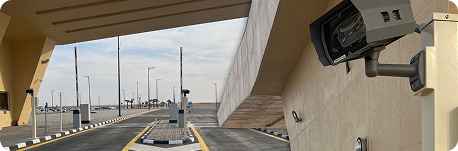
Vehicles must be verified before entering logistics facilities, port terminals, industrial sites, and inspection zones. Vehicle identification subsystems support these entry points by capturing and structuring vehicle identity for gate, security, and operational systems.

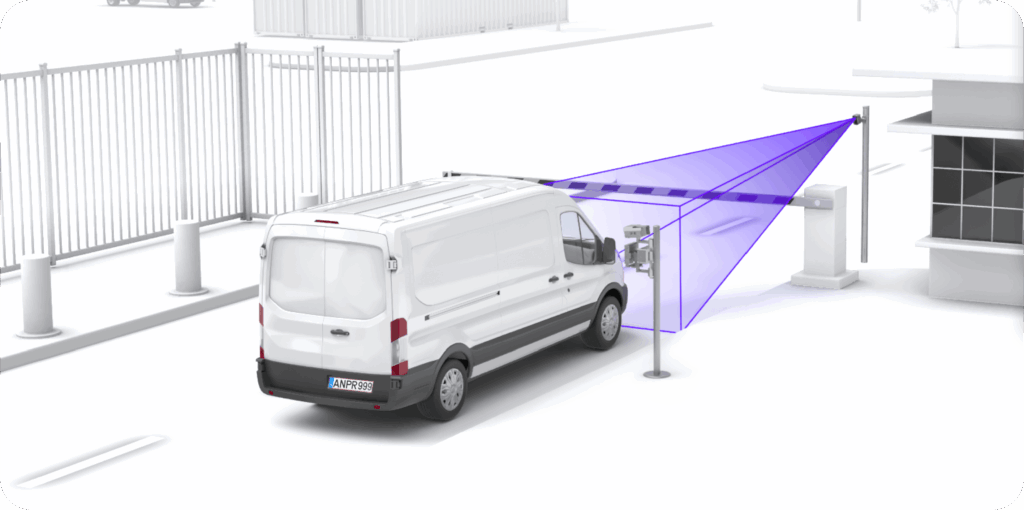
Logistics Center Access

Manage vehicle identification across entry points, yard operations, loading areas, and exit gates to improve logistics flow and operational visibility.

Logistics Center Access

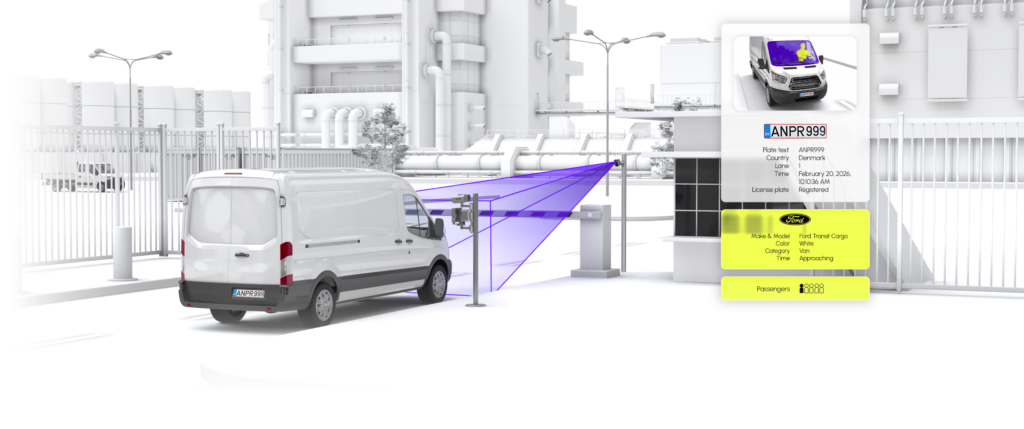
3D illustration of a white cargo van at a secure facility entrance checkpoint, where a pole-mounted ANPR camera scans the vehicle at the barrier gate.

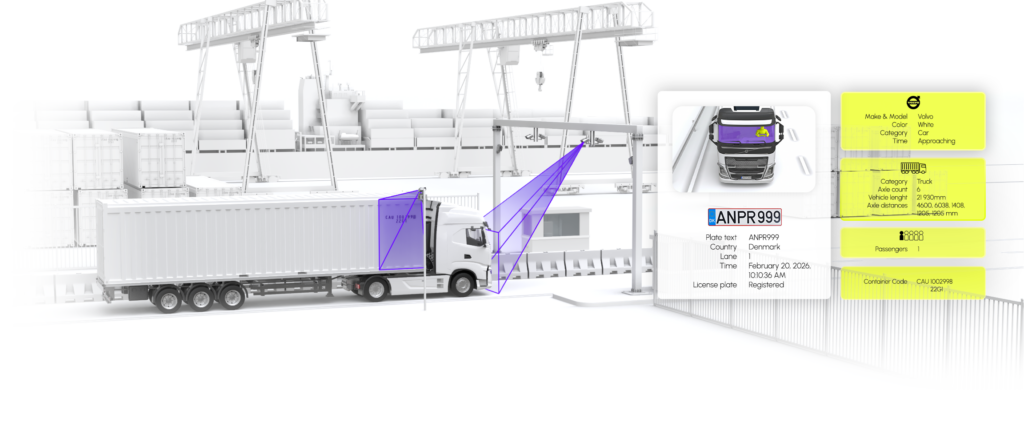
Industrial Site Access

Manufacturing plants and industrial campuses manage vehicle entry to protect operational zones and sensitive infrastructure while maintaining reliable identification of incoming vehicles.

Industrial Site Access

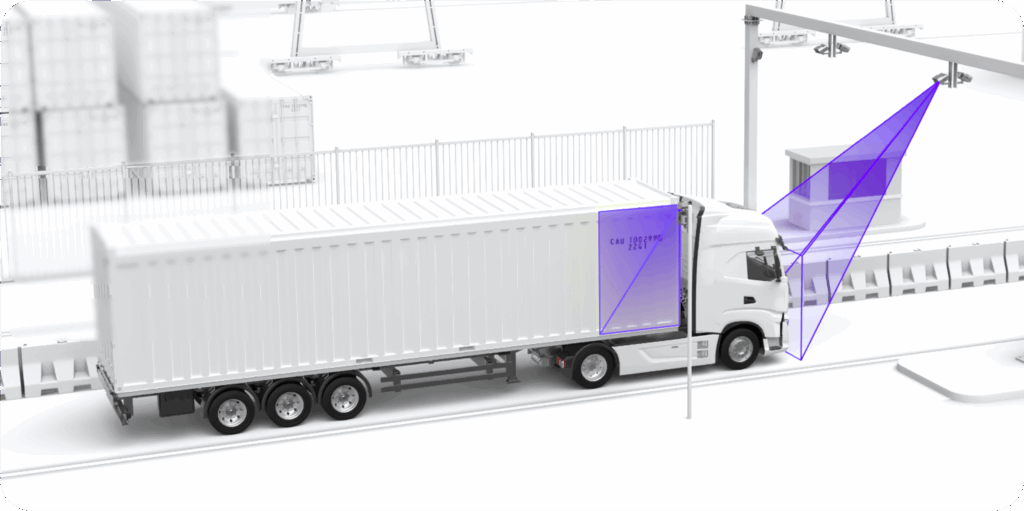
3D schematic of an automated logistics gate system with overhead cameras scanning a truck's front license plate and a shipping container's identification code.

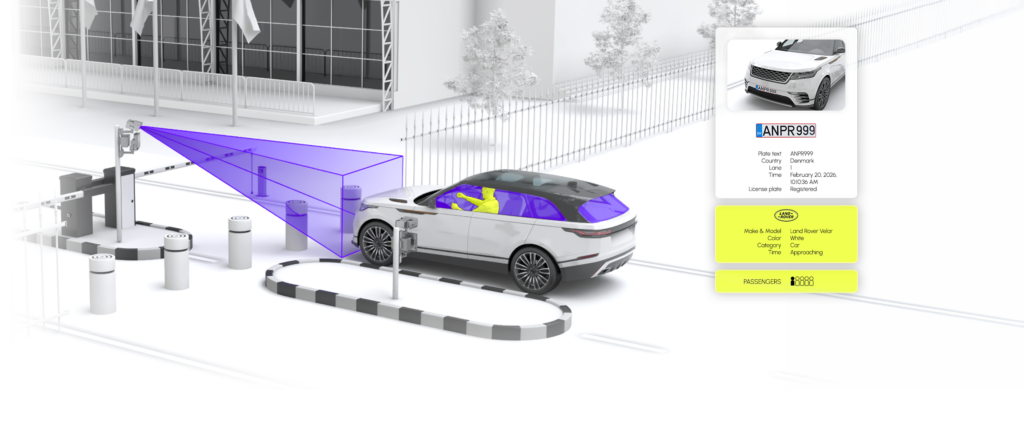
Port Terminal Access

Port terminals coordinate vehicles entering controlled cargo areas where vehicle identity, vehicle characteristics, and access records must align with terminal operations and security procedures.

Port Terminal Access

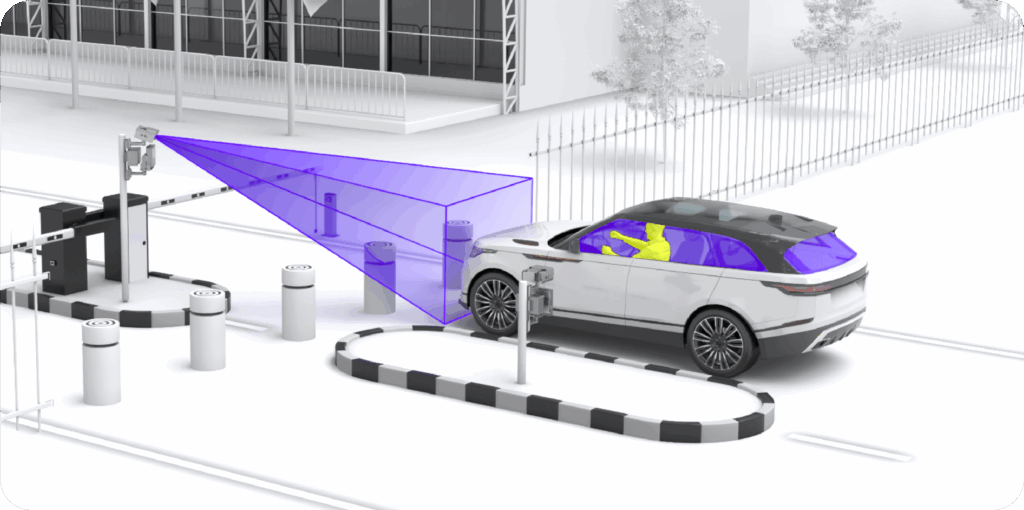
3D illustration of an automated security gate where a pole-mounted ANPR camera scans an approaching SUV, highlighting the driver for advanced access control and vehicle identification.

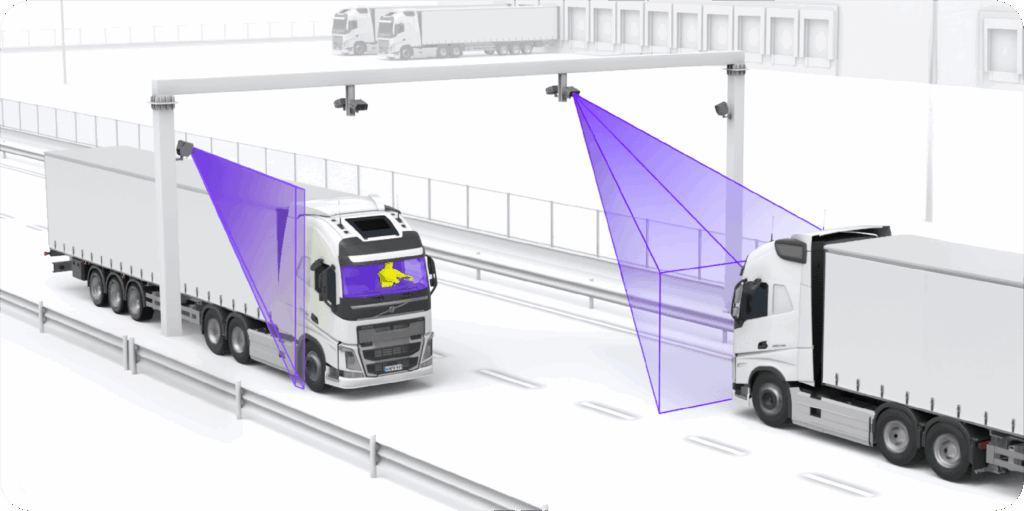
Security & Inspection Checkpoints

Inspection points and security-controlled sites record vehicles entering restricted areas where traceable vehicle records support security, inspection workflows, and operational oversight.

Security & Inspection Checkpoints

Engineered for Demanding
Access Environments

Designed to generate validated vehicle access events that remain consistent, traceable, and defensible under real-world operational conditions.

Integration at the Event Layer

Validated vehicle access events are delivered through documented APIs and modular interfaces, allowing gate systems, logistics platforms, and security systems to consume reliable vehicle identity data.

Configured for Real-World Lane Conditions

Recognition components are deployed according to lane geometry, traffic patterns, and environmental conditions, ensuring reliable vehicle identification across multi-lane gates and high-throughput access points.

Built for Long-Term Operational Stability

Industrial-grade components and system-level configuration support stable performance and traceable access records in environments where authorization decisions must withstand review.

Structured Vehicle Intelligence
for Secure Access

Effective access control requires more than plate recognition. Access systems rely on validated vehicle identity data that supports secure decisions and automated processes — generating structured vehicle access events that are timestamped, traceable, and ready for integration into operational and security systems.

Multi-Parameter Vehicle Verification
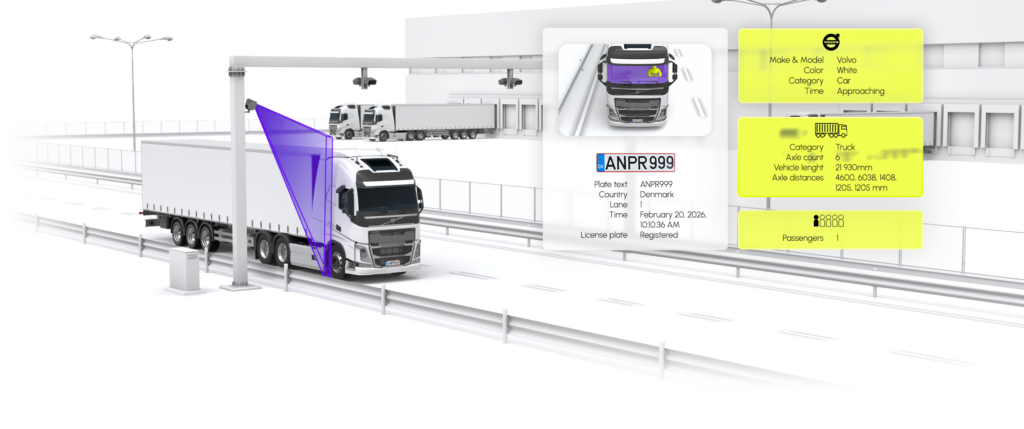
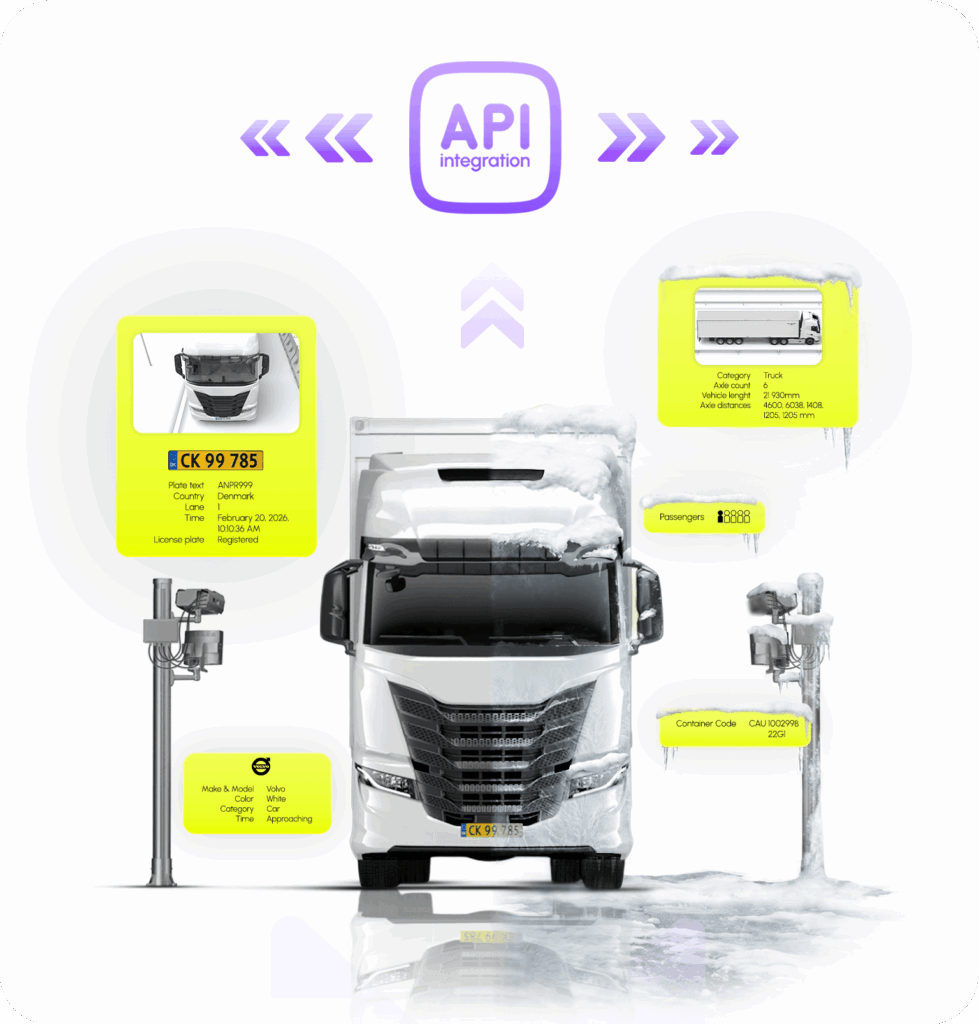
Combine license plate recognition with additional vehicle attributes such as make and model identification, axle counting, passenger detection, and image evidence to generate a validated vehicle profile at every access point.
Structured Data, Delivered to Your Existing Systems
Vehicle identity events are delivered to access control platforms, logistics systems, and security infrastructure through documented APIs — enabling integration without replacing existing systems.
Engineered for Stable, 24/7 SLA-Backed Operation
Designed for mission-critical access environments with proactive monitoring, rapid support, preventive maintenance, and SLA-backed service throughout the system lifecycle.
Built for Integration
into Access Infrastructure
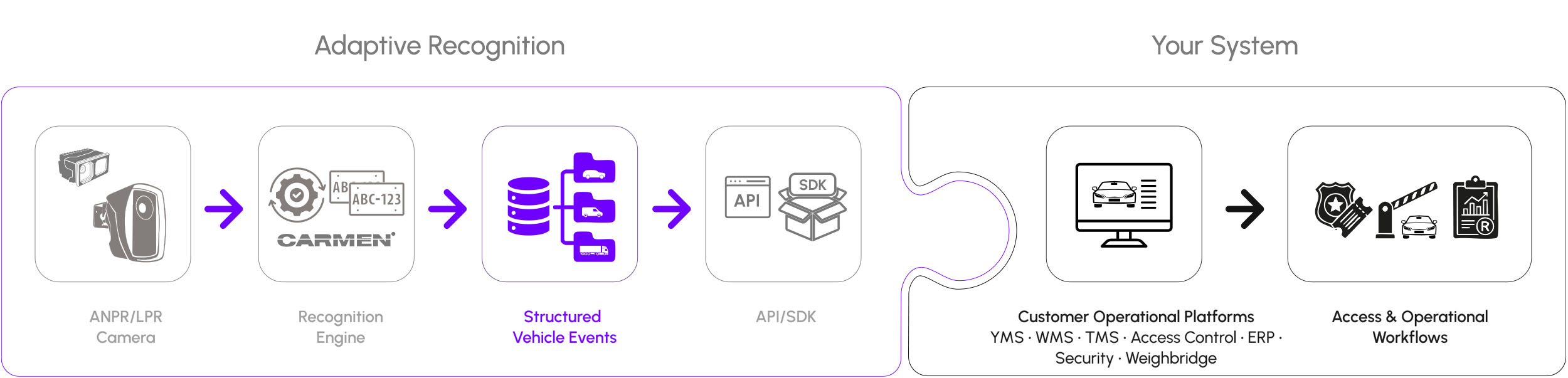
Vehicle data systems must integrate into existing access infrastructure without disrupting operational workflows. Adaptive Recognition operates as a structured vehicle identification subsystem, generating validated vehicle events that integrate with gate hardware, operational platforms, and enterprise systems through documented interfaces from initial deployment through long-term operation.
A diagram showing the integration puzzle between Adaptive Recognition's ANPR camera, Carmen recognition engine, structured vehicle events, and API/SDK into a customer's operational platforms for access and security workflows.
Planning an Access Control Deployment?
When Organizations
Reassess Access Infrastructure

Access control systems are rarely redesigned without a catalyst. In practice, organizations revisit vehicle access architecture when:

A security incident exposes verification gaps
Logistics expansion increases daily vehicle volume
Audit findings require improved traceability
A new facility or access point is under construction
Gate throughput becomes a persistent bottleneck
Legacy LPR systems approach end-of-life
Regulatory requirements tighten around documentation and vehicle access control
What Experienced Teams
Evaluate Before Deployment

Before deployment, experienced teams examine how vehicle intelligence systems align with security requirements, operational workflows, system architecture, and long-term infrastructure planning.

Verified
Access Decisions

Access authorization relies on structured vehicle events — not isolated image reads. Multi-parameter validation ensures reliable decisions at each entry point.

Structured
Audit Trails

Each vehicle passage generates a timestamped, correlated access record — enabling clear traceability for incident review, internal reporting, and regulatory documentation.

Consistent
Event Integrity

Recognition logic, attribute validation, and confidence checks are completed before vehicle identity events are transmitted — so security workflows rely on validated data, not raw captures.

Incident
Reconstruction Capability

Correlated entry and exit records support investigation, allowing teams to reconstruct vehicle movements when security events require review.

Controlled
Gate Throughput

Validated vehicle access events ensure consistent entry decisions across single- and multi-lane access points, reducing manual intervention during peak traffic periods.

Stable
Daily Operation

Structured capture logic and calibrated deployment reduce variability in vehicle reads, maintaining predictable gate behavior over time.

Reduced
On-Site Friction

Automated authorization and clear event handling reduce reliance on visual inspection and manual overrides during routine access.

Escalation
When Needed

When verification conditions are not met, structured event logic enables secondary inspection workflows without disrupting site operations.

Defined
System Boundaries

The vehicle identification layer functions as a separate subsystem, delivering structured access events without overlapping customer authorization logic.

Standardized
Event Interfaces

Validated vehicle access events are transmitted through documented APIs, enabling integration with access control platforms, ERP systems, and security infrastructure.

Deployment
Model Flexibility

The architecture supports distributed capture points, multi-lane configurations, and phased expansions without requiring structural redesign.

Predictable
Data Structure

Vehicle identity events are generated after recognition logic and attribute validation, so downstream systems receive structured, consistent records rather than raw image data.

Designed for
Demanding Environments

Vehicle identification components operate in industrial, logistics, and security-sensitive environments where consistent performance under varying conditions is required.

Calibrated to
Site Geometry

System configuration aligns with lane layout, vehicle mix, and traffic behavior — ensuring reliable data capture within a coordinated access architecture.

Multi-Year
Deployment Continuity

Engineered components and structured system logic support long operational lifecycles aligned with infrastructure investment horizons.

Maintainable
System Architecture

Clear subsystem boundaries and defined integration interfaces enable predictable updates and long-term maintainability without disrupting customer system logic.

Deployed Across
Industrial and Security-Controlled Environments

Vehicle intelligence systems are deployed across logistics hubs, industrial facilities, ports, and security-sensitive sites where controlled access and traceable vehicle data are operational necessities.

Planning an
Access Control Deployment?

Adaptive Recognition horizontal logo 2024
OUR REFERENCES

Go beyond the claims, see the proof.
Explore our reference projects and
case studies for tangible evidence of
how Adaptive Recognition delivers
exceptional outcomes

OUR RESOURCES

By those who see challenges as opportunities and rewrite the definition of impossible every day
Follow Adaptive Recognition