
Why Field-Tested Recognition Matters More Than Promises
Integrators know better than anyone that an enforcement system can look perfectly stable — traffic flowing, dashboards green, reports clean — until one recognition error turns the entire operation upside down.
A disputed ticket. A municipality asking questions. A support ticket that lands right back on your table.
What should have been a quiet background task suddenly becomes hours of investigation, calls, explanations, and escalation. And all of it originated from a single point of failure: recognition that didn’t hold when it mattered. Authorities experience the same fragility from a different angle: public trust, fairness, compliance, and political scrutiny.
As we move into 2026, the margin for “almost accurate” performance is gone. Enforcement must get the decision right the first time — not because it looks good in a spec sheet, but because society demands it.
Enforcement accuracy is still essential — but today it isn’t the headline. It’s the entry ticket to something more important: trust.
When One Wrong Read Becomes Everyone’s Problem
The error might seem small, but the consequences rarely are. For integrators, a misread plate becomes manual reviews, site visits, long email threads, and unexpected costs. Hours vanish into a problem that shouldn’t have existed. Authorities, meanwhile, face the public story. A citizen questions fairness. A journalist calls. Operators spend their time reassuring instead of managing.
Both sides are reacting to the same thing: a system that failed at its single non-negotiable job — correct recognition, every time. The difference between fragile enforcement and trusted enforcement becomes clear only in real deployments. That’s where accuracy stops being a claim and starts shaping outcomes.
Real Stories from the Field: Denmark, Serbia, Zambia, Hungary
Understanding trustworthy accuracy doesn’t come from slides — it comes from deployments that survived real pressure, real weather, real deadlines, and real people. Here’s what that looks like:
Denmark — When Accuracy Keeps Large-Scale Systems Quiet
In Denmark’s nationwide automated tolling system, accuracy wasn’t a bragging point — it was simply expected. What mattered more was what that accuracy enabled at scale:
- detecting anomalies such as cloned or reused license plates,
- maintaining consistent recognition across very high traffic volumes,
- reducing disputes through clear, automated decision-making,
- supporting a nationwide tolling system that operates reliably without constant human intervention.
These outcomes created the trust that mattered most: authorities trusted the system’s decisions, integrators trusted its stability, and the public rarely questioned the fairness of the process.
Accuracy stayed in the background. Its impact did not.
Serbia — Enforcing What People Never Think About
Serbia’s multi-lane highway enforcement faces an unusual threat: overfilled sugar-beet trucks. At tunnel entrances, beets shaken off the overloaded cargo hit the road at 100 km/h — causing accidents drivers never see coming.
Vidar cameras provided reliable plate, make/model, color, and ADR detection at speed. What once required manual inspection became automated clarity.
This wasn’t about numbers. It was about preventing accidents that 98% of people don’t know are possible — and giving authorities evidence strong enough to regulate them confidently.
Zambia — Solving the Integrator’s Real Pain Point: Project Risk
Deploying a nationwide speed enforcement program in Zambia can take 3 years of permits, approvals, and funding — a timeline that can bury an integrator before the first order arrives.
The breakthrough wasn’t just the S1 portable camera. It was the strategy:
- start with 1–2 devices at municipal level,
- gather real violation data,
- demonstrate measurable impact,
- expand step by step.
From a small pilot toward a steadily expanding deployment — not because someone believed a spec sheet, but because real-world results are building confidence at every level.
Accuracy played its role, but the real win was lowering project risk.
Hungary — Accuracy at Scale, Proven Over Years
Hungary’s nationwide enforcement network — thousands of units across highways, cities, and rural areas — is the definition of a stress test. If anything were weak, the scale would expose it immediately.
Yet year after year, the system delivers:
- clear, evidentiary images,
- consistent recognition,
- stable operation in every season,
- and a level of reliability that authorities no longer question.
The takeaway isn’t the size of the system. It’s the fact that it remains quiet — which is the greatest compliment an enforcement system can earn.
What Trustworthy Enforcement Is Actually Built On
After decades of deployments across very different enforcement environments, the same foundations appear again and again:
- Performance in real, imperfect conditions
Rain, glare, winter darkness, harsh angles — these are where enforcement systems prove themselves. Carmen® was trained on global, real-world data, not laboratory samples.
- Understanding the full vehicle, not just the plate
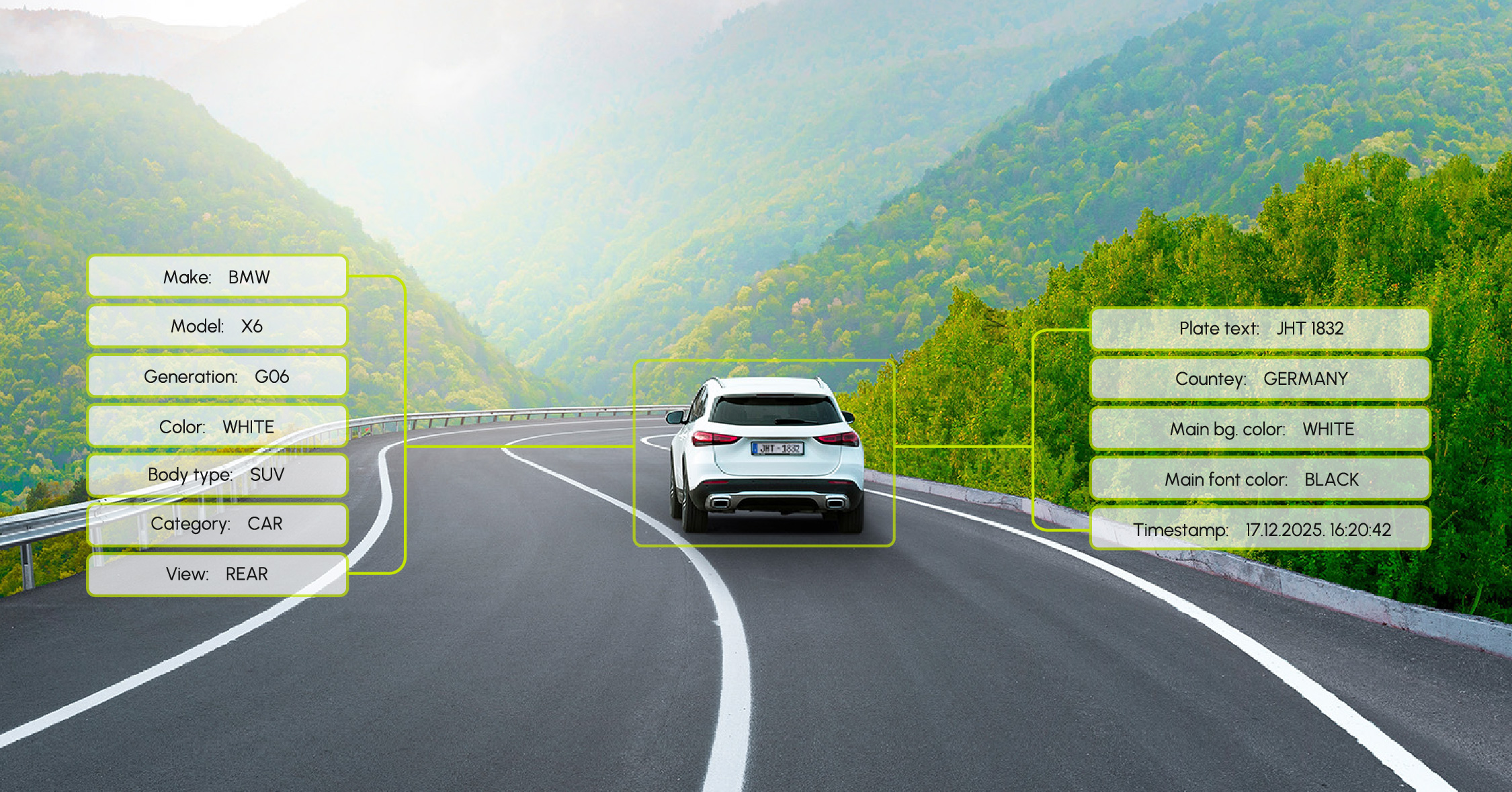
Make, model, color, ADR detection — each adds a layer of certainty, reduces reviews, and prevents disputes.
- Evidence that speaks for itself
A crisp close-up, a wide-angle context view, metadata, timestamps — clarity that doesn’t require explanation.
- Hardware and software designed as one ecosystem
Vidar Speed and Lynet deliver illumination and imaging built expressly for Carmen®, producing decisions that stand up under audit, legal evaluation, and public scrutiny.
These elements are the real architecture of trust.
Why Integrators Win When Accuracy Stays Quiet
When recognition works the way it should, enforcement systems become almost invisible — and that’s when integrators truly start to win.
Support teams stop chasing screenshots and edge cases. Disputes no longer bounce back from municipalities. Field visits turn from emergency troubleshooting into planned, predictable work. Instead of firefighting individual incidents, integrators can focus on what actually grows their business: expanding deployments, refining use cases, and building long-term relationships with their customers.
This is where accuracy reveals its real value. Not as a headline figure, but as a form of protection: protecting margins by reducing operational overhead, protecting partnerships by minimizing friction, and protecting credibility in environments where every decision may be scrutinized.
It’s no coincidence that this pattern repeats across deployments in Denmark, Serbia, Zambia, and Hungary. These systems weren’t built to impress in demos — they were shaped by decades of field experience, refined under real traffic conditions, real regulations, and real consequences. That experience is embedded into every layer of the portfolio: from Vidar Speed with its METAS-certified 4D radar, through Lynet’s mobile flexibility, to the S1’s rapid, infrastructure-free deployment.
Because when accuracy is truly field-proven, performance doesn’t drift. Day one doesn’t look different from day one thousand.
Where the Industry Is Heading in 2026
Cities expect fairness. Governments expect transparency. Integrators expect long-term reliability. Citizens expect correctness.
Accuracy underpins all of these, yes — but the differentiator is no longer the accuracy percentage. It’s whether the system:
- works everywhere, not just “ideally,”
- adapts to local challenges,
- reduces operational friction,
- earns trust quietly, consistently, invisibly.
Systems that are “almost accurate” often look cheaper at first — until the real costs surface. Disputes, manual reviews, weak evidence, and public pushback are only the beginning.
What follows is a sharp rise in operational costs: repeated site visits, servicing, fuel, human resources, and constant intervention to keep unreliable components running. What was saved upfront in CAPEX is quietly pushed into OPEX — paid every month, often for years.
By the time this becomes visible, organizations have often spent the equivalent of a high-quality system multiple times over — without ever achieving its reliability. The result isn’t just financial loss, but reputational damage tied to a supplier choice that couldn’t hold up in real operation.
Field-proven performance avoids them entirely.
Ready to build enforcement systems that stay silent?
Whether you’re planning a tender, expanding an existing network, or testing a new enforcement concept, let’s design a system that fades into the background—because it simply works.
Bring your environment, constraints, and goals. We’ll bring 34 years of experience, lessons learned on five continents, and technology that has already proven itself under real pressure.
Contact us — and let’s start building the next chapter of your enforcement success.
